
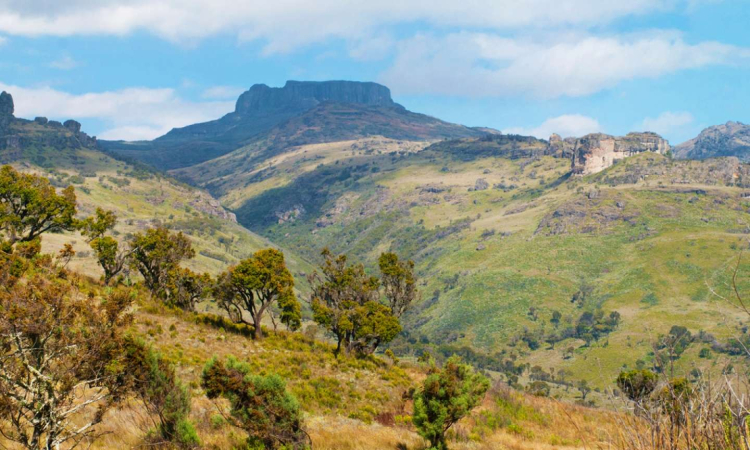
Mount Elgon National Park is located on the border between Uganda and Kenya and covers about 4,000 km². On the Ugandan side, it spreads across Mbale, Kapchorwa, Bududa, and Sironko districts. The park is managed separately by Uganda and Kenya.
The highest peak is Wagagai at 4,321 m on the Ugandan side. Other peaks include Koitoboss at 4,222 m on the Kenyan side, Kionyo, Mubiyi, and Jackson’s Summit.
The park has many caves formed by volcanic activity. Kitum Cave is one of the most famous, known for attracting elephants and buffaloes that dig the salt from its walls. Tutum Cave is another, often used as an overnight shelter for hikers trekking towards the summit on a 3–4 day circuit.
Mount Elgon is home to more than 300 bird species, making it a good place for bird watchers. Some birds are only found here, such as Jackson’s francolin, Hartlaub’s turaco, Tacazze sunbird, moorland francolin, eastern bronze-naped pigeon, and the lammergeier. Birds live in the forests and moorlands and play an important role in the balance of the park’s ecosystem.
The park also shelters elephants, buffaloes, spotted hyenas, oribis, antelopes, forest duikers, and primates like baboons, blue monkeys, and black-and-white colobus monkeys. Smaller animals such as bushbucks, porcupines, tree hyraxes, rodents, and bats can also be seen. Insects like crabs, spiders, and flies are also part of the ecosystem.
Flora is equally rich, with over 400 species of plants. These include orchids, giant groundsels, ground lobelias, cedar, Elgon olive, and podocarpus. Vegetation changes with altitude: montane forest (2,000–2,500 m), bamboo (2,500–3,000 m), heath and moorland (3,000–3,500 m), and high open moorland above 3,500 m.
Mount Elgon is also a key water catchment. Its forests store and release water into permanent rivers such as those flowing to Lake Victoria and Lake Turkana.
Mount Elgon National Park supports a wide range of biodiversity and ecosystems, shaped by its geography and altitude.


