
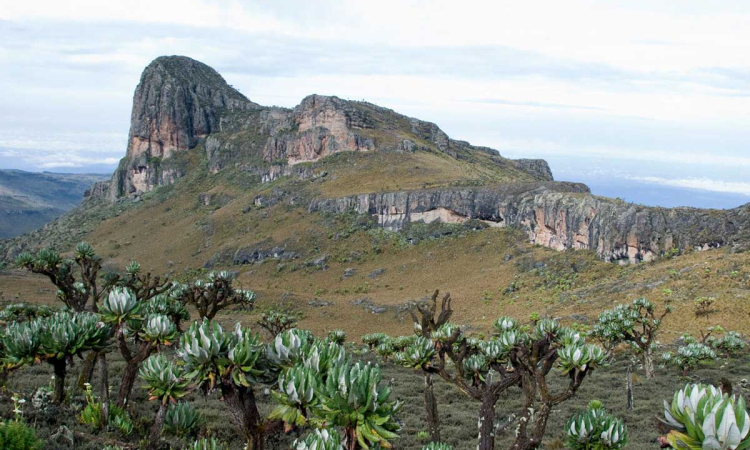
Are there glaciers on Mount Elgon? When thinking about the height of Wagagai Peak on Mount Elgon, many assume that the mountain has permanent ice fields. The answer is no.
About 24 million years ago, Mount Elgon is believed to have had glaciers because its highest peak was over 5,000 m. However, due to erosion, the peak reduced to 4,321 m, which is too low to sustain glaciers. Global climate changes also contributed to their loss.
The equilibrium line for snow accumulation is between 4,500 m and 4,800 m, and Mount Elgon does not reach this height. Even with heavy rainfall, water evaporates quickly due to strong sunlight and higher temperatures.
Evidence of ancient glaciers can still be seen on the slopes of Mount Elgon through the features they created. The most prominent is the U-shaped valley, a wide deep valley carved by moving glaciers. The Sipi River Valley is the main example.
At the heads of U-shaped valleys are hollows called cirques, formed by glaciers rubbing against rocks. Some cirques now hold lakes, such as Lake Kitandara.
Glaciers also contributed to the deep and fertile soils along Mount Elgon’s slopes, which today support farming for nearby communities.
Although the summit no longer has glaciers, it still holds alpine moorland ecosystems found above 3,500 m. Plant species in this zone include giant heathers, tussock grasses, giant senecios, and lobelias.
Mount Elgon does not have glaciers today, but tourists can still walk across landscapes shaped by ancient ice.


