
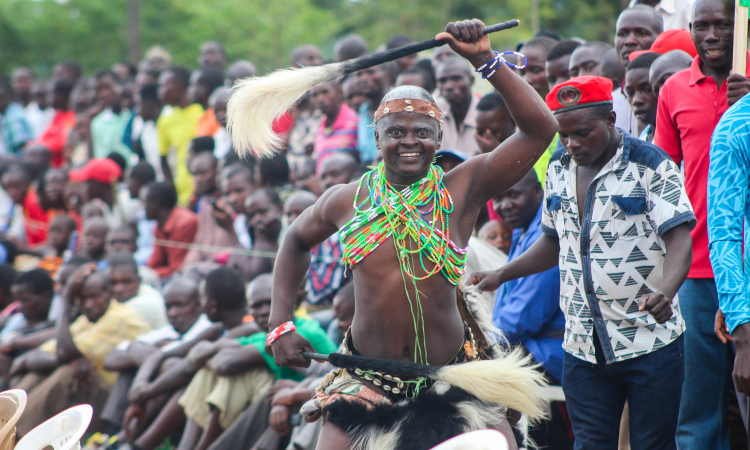
The Imbalu is a cultural ritual practiced by the Bagisu people of Eastern Uganda, who live on the lower slopes of Mount Elgon. It involves the circumcision of boys to mark their transition into adulthood. This ritual is the most famous tradition of the Bagisu and is seen as a sign of strength and bravery.
The Imbalu is a very old practice that has been carried out for many generations, though its exact origin is not known. Some people believe the Bagisu adopted it from the Kalenjin people of western Kenya, who live along the Uganda-Kenya border. For the Bagisu, the practice is mandatory for all males.
The ceremony is unique to the Bagisu. Before circumcision, boys are smeared with white powder and perform the Kadodi dance. This dance is full of energy, with stamping feet and movement through the village. The boys to be circumcised stand in the middle while the crowd sings and dances around them. The circumcision then takes place, and the foreskin is removed.
During the process, the boys are expected to stand firm without crying or showing fear, as this is proof of strength. The circumcision is done with a sharp knife called Iyembe. Because the knife is very sharp, the process usually takes between 10 and 30 seconds.
After the ritual, the boys are considered men. They wear traditional garments that show their strength, which is often admired by girls in the community.
Some men fear the practice and may try to run away from their villages. However, if caught, they are brought back and circumcised by force. In the community, an uncircumcised man is not allowed to marry and is seen as a coward and unclean.
The Imbalu tradition is one of the main cultural practices that identifies the Bagisu. It has preserved their heritage for many years and has also become a cultural attraction for visitors in Eastern Uganda.


